Altitude sickness on Kilimanjaro
Every evening on the mountain I check each climber for altitude-sickness symptoms and measure heart rate and blood-oxygen level, and on summit night we check more often. One guide walks in front and sets the pace, we stop often to drink, and we carry emergency oxygen. [NEEDS JOSEPH: your turn-around rule, e.g. the oxygen level or symptoms at which a climber goes down (follow-up question 7)]
Key facts
- Health check
- Every evening: symptoms, heart rate and blood oxygen
- Summit night
- Checked more often, emergency oxygen carried
- Guides per group
- At least two, however small the group
- Turn-around rule
- [NEEDS JOSEPH: the oxygen level at which a climber goes down (follow-up question 7)]
- Summit altitude
- Uhuru Peak, 5,895 m
How does my crew keep you safe?
- Every group has at least two guides, however small. One walks in front and sets the pace. The other walks at the back, so nobody falls behind and nobody is alone.
- We stop often for water and snacks. "Sippy sippy!" And we keep asking whether the pace is right for you.
- You get every meal on the mountain, and more food than you can eat, so you stay full and strong.
- Every morning we fill your water bottles before we start walking, and the porters make sure there is always fresh water at camp.
- Every evening I do a health check with each climber. I ask about altitude-sickness symptoms and measure your heart rate and blood-oxygen level.
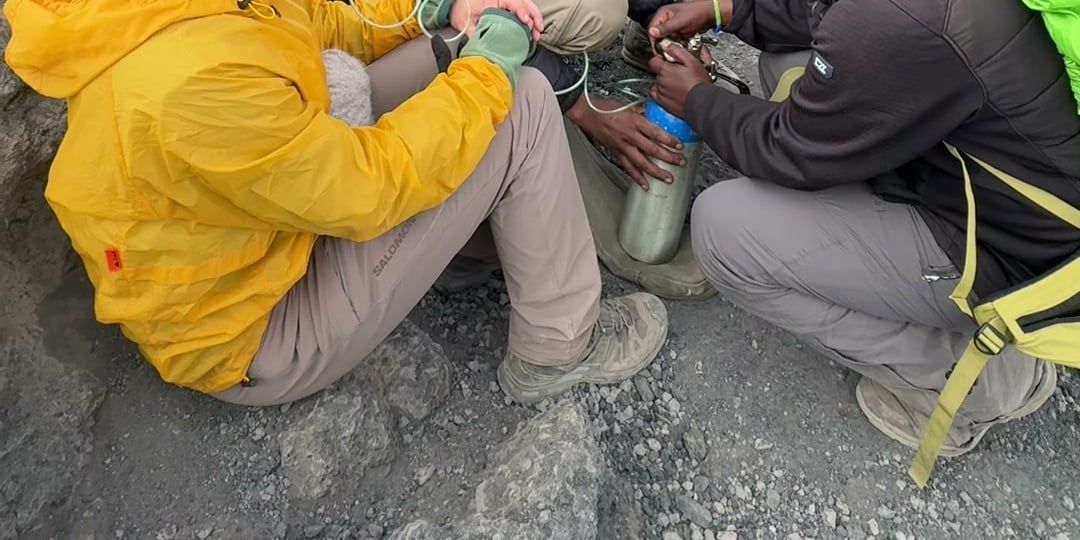
- On summit night we check more often as we climb. We carry emergency oxygen in case your oxygen level drops too low, and extra summit porters walk with the group to help in an emergency and to carry your day pack.
What are the symptoms of altitude sickness?
[NEEDS JOSEPH: the symptoms you ask about at the evening check, in plain words, with a link to a medical source (e.g. a national health service or a mountain-medicine society) that Cobus and Joseph choose together. Don’t add medical advice without a source.]
What happens if I get altitude sickness on the climb?
[NEEDS JOSEPH: what you do, step by step: rest, a slower pace, going down, oxygen. Who decides, and how the descent works.]
When do you turn a climber back?
[NEEDS JOSEPH: your rule (follow-up question 7), e.g. the oxygen level, symptoms or behaviour at which a climber goes down.]
Have I had to take a climber down? Yes. Not long ago I was guiding a private group of two climbers. On summit night we went up with me, my assistant guide and three summit porters. One climber’s oxygen level dropped below a safe level, and we decided to take her down quickly. Two of the porters and I took her down and stabilised her at base camp. My assistant guide and the third summit porter guided the other climber safely to the top and back down.
This is why every group has at least two guides, however small. One guide can take a climber down while the other carries on with the rest of the group.
Which routes help you acclimatise?
For first-time climbers I recommend the Machame route or the Lemosho route. Both give your body time to acclimatise, and more climbers reach the summit on them.
[NEEDS JOSEPH: why, e.g. “climb high, sleep low” days such as Lava Tower to Barranco, and whether an extra day helps. See the altitude profile on each route page.]
Real cases from the mountain
The summit night above, when my assistant guide took one climber to the top while I took the other down, is one of them.
[NEEDS JOSEPH: one or two more anonymised examples from your climbs: what the readings showed, what you did, and how it ended.]
Questions people ask
How do guides check for altitude sickness?
Every evening I do a health check with each climber. I ask about altitude-sickness symptoms and measure your heart rate and blood-oxygen level. On summit night we check more often as we climb.
Do you carry oxygen on Kilimanjaro?
Yes. We carry emergency oxygen in case your oxygen level drops too low.
Which route is best for acclimatisation?
For first-time climbers I recommend the Machame or Lemosho route. Both give your body time to acclimatise.
Have you ever had to take a climber down?
Yes. On a recent summit night one climber's oxygen level dropped below a safe level. Two summit porters and I took her down and stabilised her at base camp, while my assistant guide and another summit porter took the other climber in her group to the top and back.
Should I take Diamox?
[NEEDS JOSEPH: what you tell climbers, with a link to a medical source. Climbers should ask their own doctor]
Want to talk it through? Message me on WhatsApp.
Message Joseph on WhatsApp